1. Cost model
“Free” can mean no upfront charge, not no revenue share. RouteNote states that its Free plan pays 85% of royalties to the creator.
AI music distribution · free-plan reality check
RouteNote documents a free distribution plan and says creators on that plan keep 85% of royalties. It also documents that AI-generated releases are blocked from its Korean-store partners. That combination is the useful decision: a no-upfront route may exist, while the store list still changes with the kind of AI release you upload.
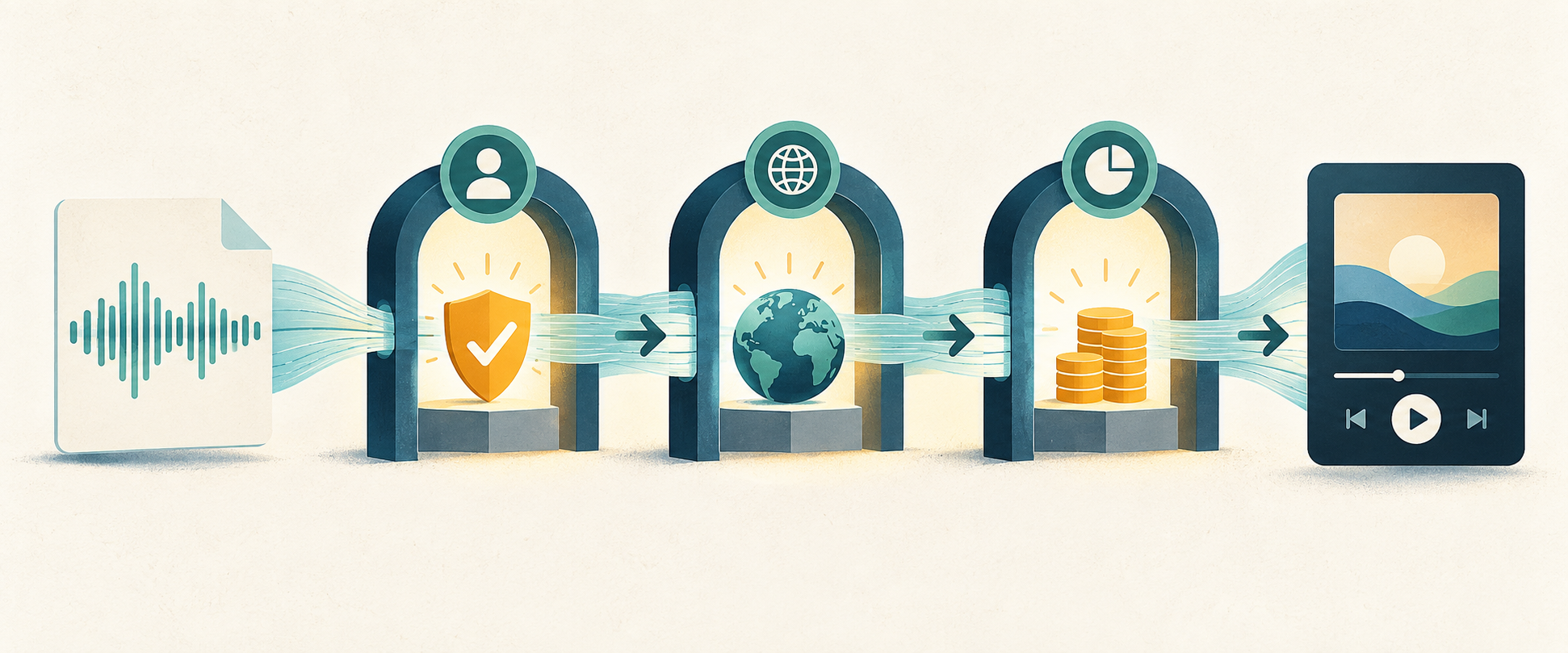
RouteNote is a documented no-upfront option for an AI-music release, provided that the release meets its rules and you accept the free-plan revenue share. Do not equate that with “every store accepts it.” RouteNote says its Korean partners—Melon, Bugs!, Flo, and Vibe—do not accept AI-generated releases. Treat the destination list as a release-level decision, not a generic distributor checkbox.
Three checks before you upload
“Free” can mean no upfront charge, not no revenue share. RouteNote states that its Free plan pays 85% of royalties to the creator.
A distributor may accept the file while particular stores refuse that category. For RouteNote AI releases, the documented Korean-store exclusions are Melon, Bugs!, Flo, and Vibe.
You still need the rights to distribute the audio, name, artwork, samples, voices, and any human contributions. A free plan does not repair a missing permission.
Documented example, not a blanket promise
| Question | Current documented answer | What to do with it |
|---|---|---|
| Is there a free distribution route? | RouteNote says it offers a Free distribution plan and describes it as having no release restrictions or hidden fees. | Read “free” as the plan’s published cost model; do not infer that it means all stores or monetisation uses are available. |
| What share does the free route keep? | RouteNote says its Free distribution model keeps 15% and pays the creator 85% of royalties. | Decide before submission whether the trade-off is acceptable for this release. |
| Can an AI release reach every store? | No. RouteNote says its Korean partners do not accept AI-generated releases and those releases will not be sent to those stores. | Remove those destinations from the expectation list before release planning. |
| Does another service being AI-friendly make it free? | No. Amuse says AI-generated music is allowed, but it also says it no longer offers free distribution. | Keep “AI allowed” and “no-upfront distribution” as two separate checks. |
These are current policy snapshots, checked 2026-10-07 (UTC). They are not an endorsement and can change.
Release workflow
The shortcut that causes confusion
Amuse is a useful counterexample. Its support documentation says AI-generated music is allowed, but it says free distribution is no longer offered. It also lists destination exclusions for AI content, including Qobuz, Meta, and YouTube Content ID.
That is why the right question is not simply “Which distributor allows AI?” Instead ask: Which plan accepts my release, what portion of revenue applies, and which stores will not receive it? The answer can differ inside one service.
Original visual: it illustrates a decision order and does not represent any platform interface or logo.
Checked source pages
Policy pages checked 2026-10-07 (UTC). This is operational information, not legal or tax advice.