Creator video upload
Use this lane for a video you publish through YouTube Studio. The relevant record is the video’s own upload details and AI-use selection.
AI music YouTube · upload lane map
These lanes use different disclosures and answer different questions. A YouTube Studio upload asks a creator to disclose qualifying AI use in the video. A music partner delivers GenAI metadata with the music. Content ID is a rights-management system for eligible owners—not a substitute for either upload path.
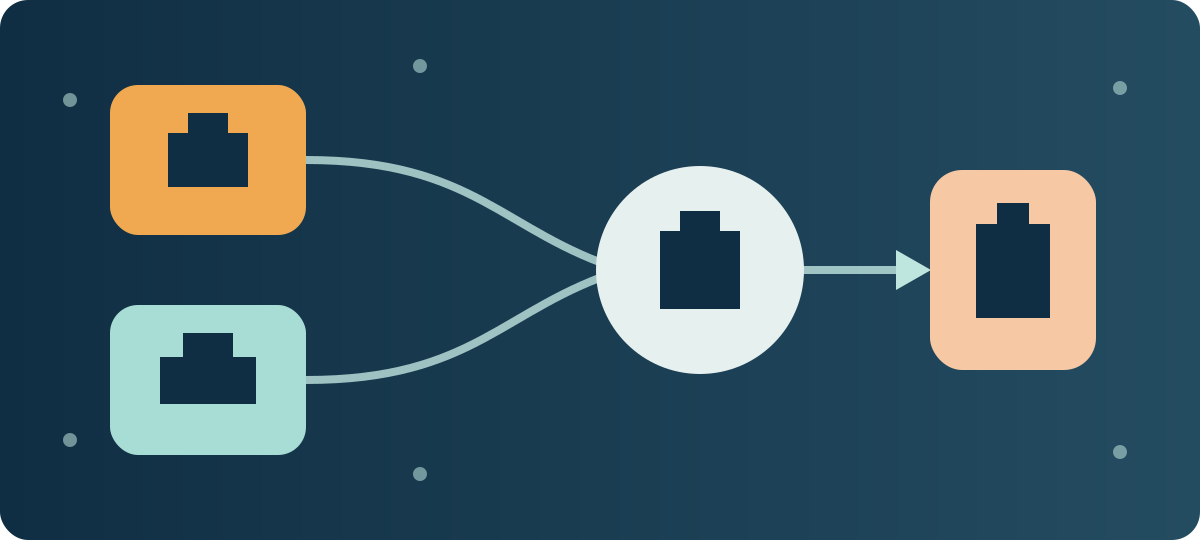
Do not treat “upload to YouTube” as one action. If you are publishing a video yourself, use the creator upload lane and complete the applicable AI-use disclosure. If a distributor or music partner is delivering the release, make sure its GenAI metadata is accurate. If you are considering Content ID, first confirm that you own sufficient exclusive rights and qualify for the separate rights-management system.
Three jobs, three records
Use this lane for a video you publish through YouTube Studio. The relevant record is the video’s own upload details and AI-use selection.
Use this lane when music is delivered with metadata through a partner. The relevant record is the release metadata and its GenAI designation.
Content ID identifies matching uploaded material for qualifying copyright owners. The relevant record is the ownership and reference-file basis for a claim.
An appearance in a listening or video surface is the outcome to check after delivery. It is not proof that the prior disclosure or rights work is complete.
What the official pages say
| Lane question | Current primary-source signal | Practical record |
|---|---|---|
| What should a creator disclose for an AI-music video? | YouTube says creators must disclose AI-generated or meaningfully altered content when it appears realistic, and lists AI-generated music among the examples. The selection is available in the Studio upload flow under “AI use.” | The selected AI-use answer, the video URL, and the reasons it applies to the actual video. |
| What GenAI information can a music partner deliver? | YouTube says music partners can designate delivered content as Fully Gen AI, Partly Gen AI, or No Gen AI through DDEX or CSV delivery templates. | The exact category given to the partner and the factual basis for it. |
| Does a music-delivery label settle Content ID? | No. YouTube says Content ID is for copyright owners meeting specific criteria, including exclusive rights to a substantial body of original material that is frequently uploaded. | Separate ownership and exclusivity evidence; do not assume a release delivery creates Content ID access. |
| What can happen when a match is found? | YouTube says uploaded videos are scanned against Content ID references and a matching rights owner can block, monetize, or track a match, with actions that may vary by geography. | A rights-management decision that is deliberately made, rather than an accidental claim strategy. |
A disclosure describes how content was made. A Content ID claim manages material a qualifying owner controls. Those are not interchangeable.
The missing metadata field
YouTube’s music-partner guidance gives concrete examples for the three affirmative GenAI values and separately says an omitted value is interpreted as unknown unless other signals support a determination. That makes the missing-value state worth recording instead of silently treating it as a negative answer.
| Delivered-music value | YouTube’s example signal | What to preserve with the release |
|---|---|---|
| Fully Gen AI | A creator enters a prompt into an AI music generator and downloads the resulting track. | The generation/output record and the partner value supplied for that exact recording. |
| Partly Gen AI | A creator generates a structural layer such as a bassline or string section, then records live vocals and instruments. | Which layers were generated and which human performances were added before delivery. |
| No Gen AI | Standard pitch correction or automated AI mastering used to adjust a finished recording. | The production-assistance note that explains why the recording was not classified as generated content. |
| No value supplied | YouTube interprets the value as unknown unless it can make a determination from other signals. | Whether the partner field was intentionally set, unavailable, or omitted—plus the submission evidence. |
Operational inference: a creator can keep two truthful records for the same project: a Studio AI-use selection for a self-published video and a delivered-music GenAI value for the sound recording. Neither record should be reconstructed later from a screenshot of the other.
Six-step workflow
Question answered
No. A creator-video AI-use selection belongs to the video upload. A delivered music release can carry a separate GenAI metadata designation through a music partner. Keep both if your project includes both a video and a delivered track, and do not treat either record as Content ID approval.
This two-lane distinction is the practical issue hidden inside “AI music YouTube.” It lets a creator prepare the right information for each surface without overclaiming what one upload path accomplishes.
Original visual: a route-planning illustration, not a representation of a YouTube interface or a policy flow.
Checked source pages
Policy pages checked 2026-10-10 (UTC). This is operational guidance, not legal advice. Rules can change.