1. Creation source
The service or workflow that produced the audio, lyrics, composition, voice, or artwork. Its current terms are part of the release record.
AI music platforms · route map
A generator, a distributor, a listening service, and a social-music surface each answer a different question. Start by mapping those roles for one release. Then check its rights, its required AI disclosure, and its permitted destinations before you upload.
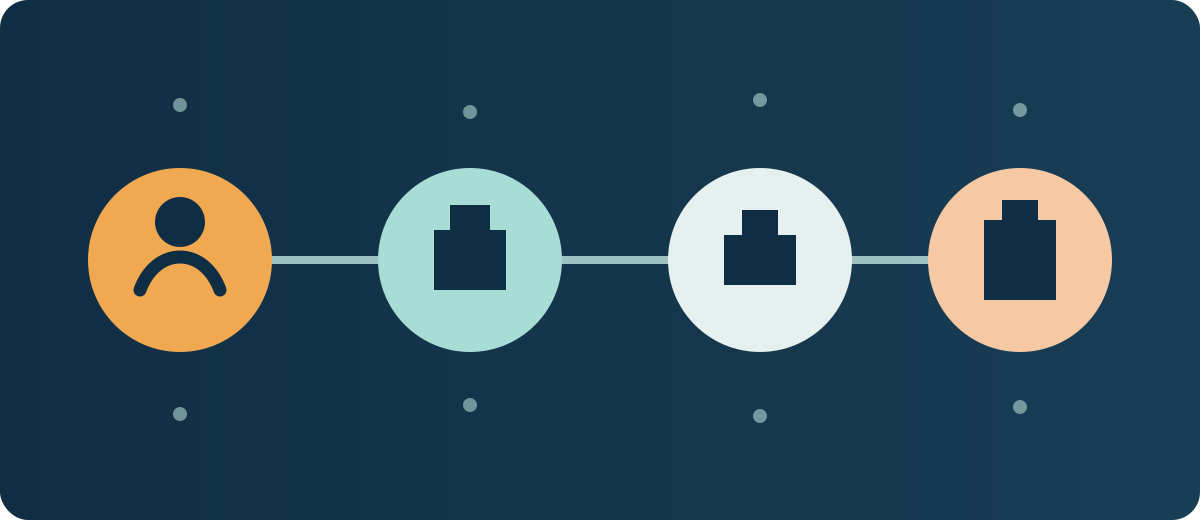
Use AI music platforms as a route, not a shopping list. Pick the tool that created the track, document your rights to distribute that output, use a distributor that accepts the release under its current rules, and select only the listening or social-music services that can receive it. A platform in one lane does not replace a platform in another.
The four-lane map
The service or workflow that produced the audio, lyrics, composition, voice, or artwork. Its current terms are part of the release record.
The distributor that receives your files and metadata, checks its own policy, and sends the release toward selected services.
The music destinations where listeners find the release. Delivery is a request to these services, not a universal publication guarantee.
The places where listeners encounter the music, such as a streaming profile, a music library, or a short-form social context. Treat each surface as a separate follow-up task.
What the current platform pages actually answer
| Question | Primary-source signal | What to put on your route card |
|---|---|---|
| Can an AI-made release enter the delivery route? | DistroKid says it accepts music made with AI tools when the uploader owns the rights and the release follows its stated content rules. | The policy URL and the date checked, plus the rights record for the exact audio and added materials. |
| Which services can display an AI disclosure? | DistroKid says its AI credits are shown by Spotify, Apple Music, and YouTube, and distinguishes generated lyrics, music, all audio, and part of the audio. | The factual AI-credit category, not a generic “AI” label. |
| Will every selected destination take the release? | RouteNote documents that its Korean-store partners do not accept AI-generated releases. | A destination list with exclusions recorded before submission. |
| What is the practical scale of a delivery route? | DistroKid says it delivers to more than 150 stores, including Spotify, TikTok, YouTube, and Apple Music. | Your actual chosen services; a large network count is not a substitute for a release-specific destination check. |
These are different layers: upload acceptance, disclosure display, and destination availability. They should not be collapsed into one platform claim.
A repeatable release check
Question answered
Yes. The delivery route sends a release toward selected destinations, but it does not turn your rights record, AI disclosure, destination exclusions, and audience-surface work into one automatic step. Keep those four records separate so you can see what is complete and what is only requested.
This separation is the practical gap behind the phrase “AI music platforms.” It turns a vague comparison into a release-specific route you can check again when a rule changes.
Original visual: a role map for release planning, not a representation of any company interface or policy.
Checked source pages
Policy pages checked 2026-10-09 (UTC). This is operational guidance, not legal advice. Rules can change.