Rights to distribute
Record the legal right to distribute the AI output and every sample, lyric, voice, image, and contribution included in the submitted release.
AI music distribution · release specification
A distributor’s “AI accepted” page is not a universal clearance. DistroKid requires 100% distribution rights and prohibits impersonation, infringement, and mass-generated spam. TuneCore says GenAI music is eligible only where the underlying model uses fully licensed datasets. RouteNote documents that some stores still exclude AI-generated releases. Make those checks one release record before choosing a route.
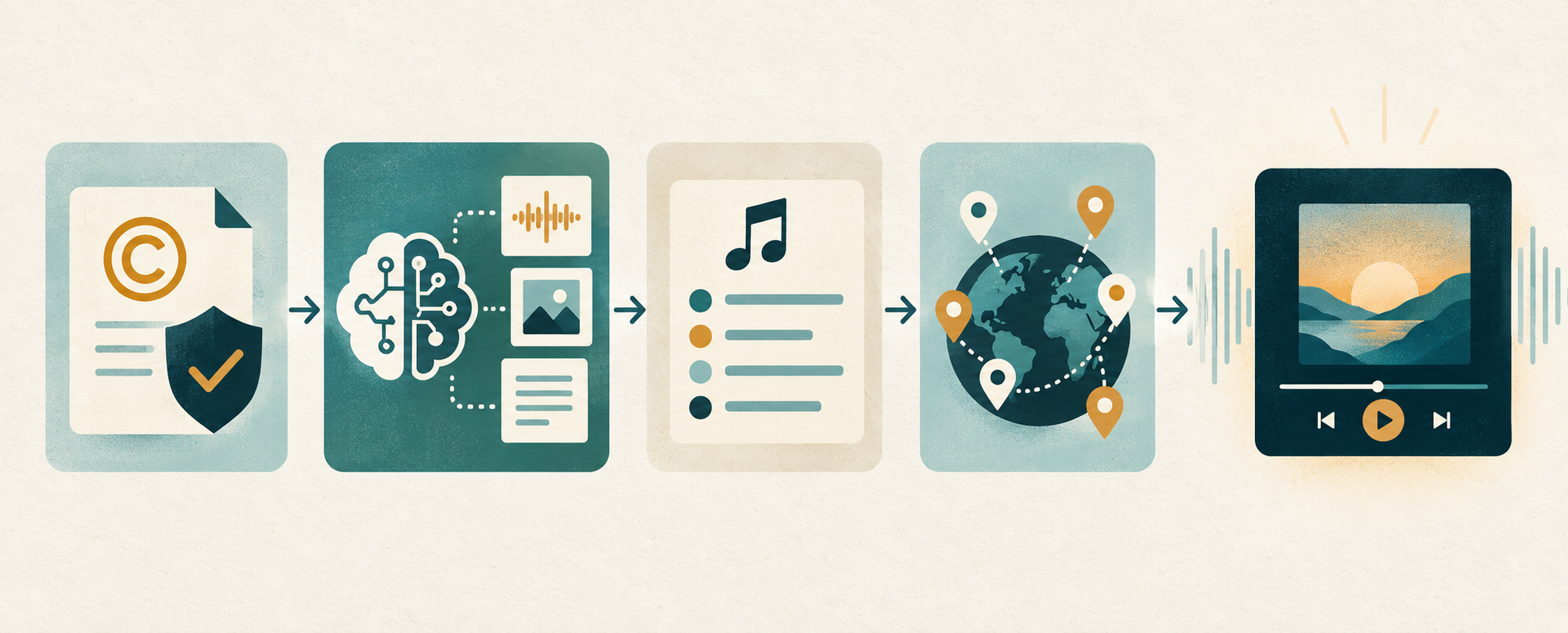
Do not choose an AI music distributor from a single “accepts AI” promise. First make a release specification: confirm your rights, document what the generation tool says about its source model and use terms, decide the accurate AI-credit category, and map any store-level exclusions. Then compare distributors against that fixed record.
The release specification
Record the legal right to distribute the AI output and every sample, lyric, voice, image, and contribution included in the submitted release.
Save the generator’s current terms, ownership statement, and any disclosure about training-data licensing. TuneCore specifically points creators to tool documentation and licensing disclosures.
Separate AI-generated lyrics, composition, all-audio generation, and part-audio generation. They are different factual descriptions, not interchangeable labels.
Write down the intended stores and the exclusions that apply to this exact release. A distributor may accept the release while individual destinations do not.
What the primary policy pages mean in practice
| Policy question | Current primary-source signal | Record before uploading |
|---|---|---|
| Can the distributor take AI-made music? | DistroKid says it accepts music created with AI tools if the release follows the stated rules. | The current policy URL and access date, not an assumption based on an older upload. |
| Who is responsible for rights? | DistroKid says the uploader must own 100% of the rights, including the right to distribute material from AI tools, samples, and lyrics. | The output-rights record plus permissions for anything added to it. |
| Does the generator’s source model matter? | TuneCore says its GenAI eligibility requires underlying models that rely on fully licensed datasets. | The generator’s relevant public disclosure or terms; if there is no clear disclosure, treat that as an unresolved compatibility question. |
| Will every store get the release? | RouteNote says its Korean-store partners do not accept AI-generated releases. | The requested store list and the stores you know are excluded for the release type. |
The table separates a distributor’s upload rule, a generator/source-model rule, and a store-delivery rule. None is a substitute for the others.
Six-step workflow
The key distinction
DistroKid’s acceptance rule asks whether you hold the rights and comply with content guidelines. TuneCore’s framework adds a source-model requirement for GenAI eligibility. RouteNote’s Korean-store rule shows that a release can be permitted at the distributor layer yet not be sent to every destination.
That layered reality is why an AI music distribution plan should start with a release specification. It makes the evidence visible before you spend time completing metadata and upload forms.
Original visual: a workflow illustration, not a representation of any company interface or policy.
Checked source pages
Policy pages checked 2026-10-08 (UTC). This is operational guidance, not legal advice. Rules can change.